A decision belongs to someone
AI can produce a comparison table in minutes. For a business owner, the work continues after that table appears on screen. They need to know which documents informed it, how the team may use it and who approves the next step. If a price or delivery date changes later, they need to identify which decision concerned which version.
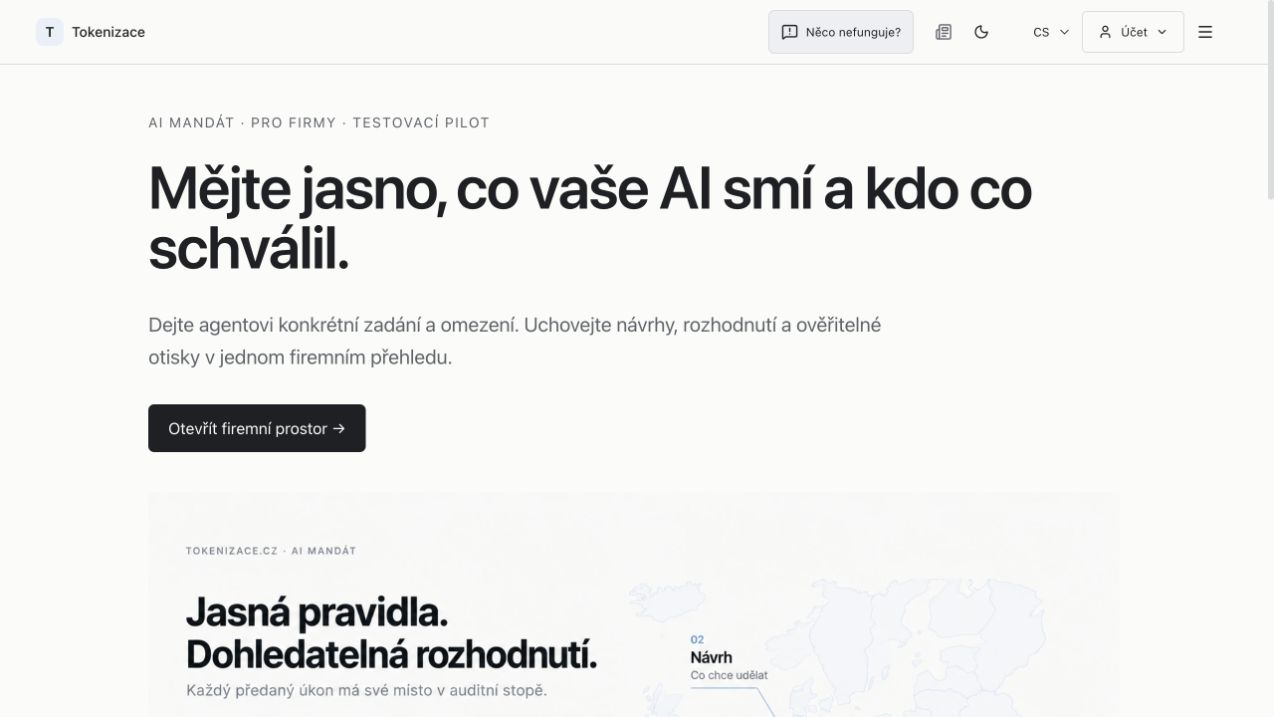
AI Mandát on Tokenizace.cz now follows July's discussion of agent authority with a test pilot. Its public guide describes a process for rules, submitted proposals and decisions by the company owner. The example below explains the purpose of that process. It is an illustrative situation, rather than a report of a verified customer deployment.
A clear assignment makes review easier
A small manufacturer is comparing two suppliers. The owner asks AI to summarise price, delivery and servicing terms. They provide two specified documents and require missing information to remain marked as unknown. The output is for an internal meeting. A person will handle any purchase order.
This assignment can be reviewed. Its purpose, inputs and boundaries are clear. According to the guide, a mandate can name the agent and define its purpose, restrictions and period of validity. A narrow task with a recognisable result is enough for a first trial. Covering the whole company at once would introduce too many unresolved questions.
Approval concerns a particular proposal
The agent prepares the comparison in its working tool. Under the published process, a particular action is submitted to AI Mandát manually or through its API, and the owner accepts or rejects it. The link to the precise document version matters. Approval of yesterday's table should not silently extend to a changed document today.
In our example, the owner might notice that the cheaper quotation omits transport. They reject the proposal and ask for the missing information; the revised version is reviewed as a new proposal. The record should help someone understand that sequence later. Ordering the goods, sending an email or changing an accounting entry are subsequent actions requiring their own authority and tools.
What a digital fingerprint establishes
The guide describes a private history, evidence export and submission of a record's fingerprint to Base Sepolia. Confirmation provides a transaction link. The public network receives the fingerprint, rather than the document or chat text. This pilot uses its own test route on Base Sepolia; it does not thereby write to Blockchain Genesis.
A fingerprint helps compare whether a presented record has changed. It cannot establish that a supplier's price is correct or that the comparison covered every important condition. The underlying document and the human decision therefore still matter. A test network is also not a permanent archive of company documents.
The scope of the record needs to be clear
Today's pilot records only actions explicitly submitted to it. It does not read every AI conversation or enforce rules outside its own environment. An API connection or compatible connector therefore needs deliberate configuration. A mandate recorded in one system cannot, by its existence alone, block an action taken elsewhere.
Owners and the people administering business tools need to understand that boundary. They should know what is recorded, who submits each record and where approval happens. With that scope defined, they can assess whether decisions can actually be traced.
Begin with one carefully scoped task
Use sample documents for an initial trial. Identify the owner, the expected result and the circumstances that should stop further work. Include a rejected proposal. At the final review, it should be possible to explain who assigned the work, what they considered and why they made that decision.
The public guide provides a starting point. A useful outcome is that a colleague can understand the decision from the retained evidence without having to read the entire original chat.